
Salads
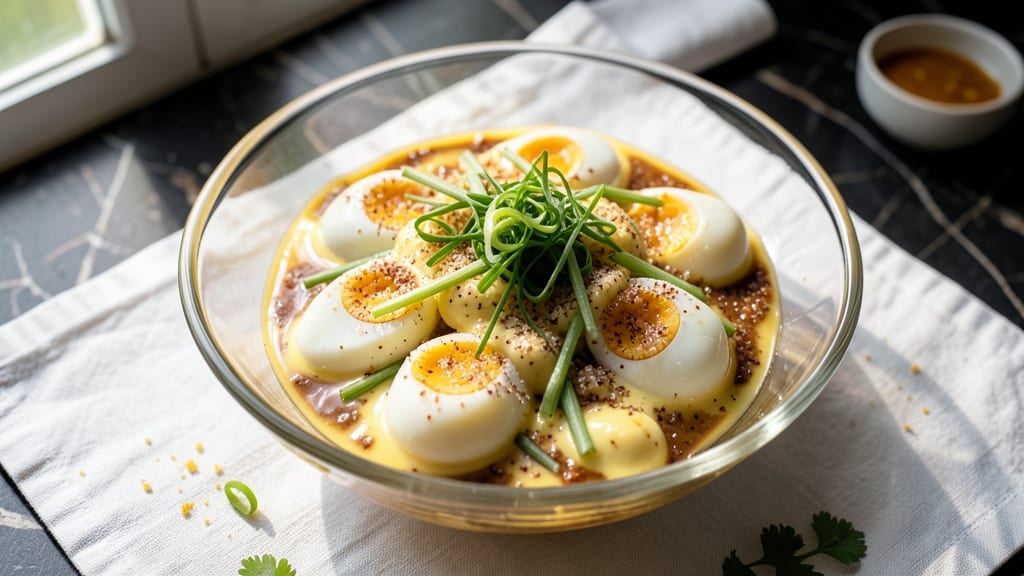
This traditional Japanese egg salad transforms simple boiled eggs into a silky, umami-rich dish with crispy celery crowns that add texture and freshness. The secret lies in the delicate balance of sweet soy glaze and dashi-infused mayonnaise, creating a harmonious bite that’s both comforting and refined.
I’ve perfected this recipe over years of Japanese home cooking, ensuring every element—from the folded eggs to the celery garnish—delivers authentic flavor without compromise.
The process begins with eggs gently simmered until just set, then carefully folded into a silky, layered texture reminiscent of tamagoyaki. A light glaze of sugar and soy sauce enhances the natural richness, while a touch of dashi (optional but recommended) deepens the savory profile.
The crispy celery crowns, lightly toasted in a pan, provide a satisfying crunch that contrasts beautifully with the soft egg filling.
What you’ll end up with is a dish that’s elegant yet approachable—ideal as a side for bento boxes, a light lunch, or an accompaniment to grilled fish. The combination of textures and flavors makes it far more interesting than standard egg salad, while the preparation remains straightforward and foolproof.
This recipe stays true to Japanese home cooking traditions while adapting seamlessly to modern kitchens.
Serve chilled or at room temperature, garnished with the crispy celery crowns for that final touch of sophistication. The balance of sweet, salty, and umami ensures every bite is memorable, proving that traditional Japanese flavors can shine in a simple yet impressive dish.
Let’s get started on creating this classic with confidence.
Ingredients for traditional japanese egg salad
Authentic Japanese flavors meet delicate textures in this refined egg salad, balancing crispy celery crowns with silky mayonnaise.
| Ingredient | Amount | Notes |
|---|---|---|
| Large Eggs 🥚 | 8 whole | Fresh, room temperature preferred |
| Japanese Mayonnaise 🍳 | ½ cup | Kewpie recommended for authenticity |
| Dashi Powder 🍜 | 1 tsp | Or 1 tbsp homemade dashi stock |
| Light Soy Sauce 🍶 | 2 tbsp | Kikkoman preferred for balance |
| Granulated Sugar 🍚 | 1 ½ tbsp | Adjust to taste for sweetness |
| Celery Stalks 🥬 | 2 whole | Thick, crisp varieties preferred |
| Vegetable Oil 🫒 | 2 tbsp | High smoke point for crisping |
| Sesame Seeds 🌾 | 1 tsp | Toasted for garnish |
| Rice Vinegar 🍶 | 1 tsp | For balancing acidity |
| Diamond Crystal Kosher Salt 🧂 | ½ tsp | Fine grain for delicate seasoning |
| Black Pepper 🌶️ | ¼ tsp | Freshly cracked preferred |
| Mirin 🍶 | 1 tbsp | For umami depth |
The eggs are the foundation, so quality matters. Kirkland Signature or Vital Farms eggs deliver consistent results, but any high-quality brand works. For the dashi, Hondashi powder from Japanese markets is ideal—it dissolves completely and delivers authentic umami. If using homemade dashi, simmer kombu and bonito flakes for 10 minutes, then strain. The celery should be thick stalks with minimal stringiness; organic celery from Whole Foods or local farmers' markets excels here. Avoid pre-cut celery, which loses crispness quickly.
No Japanese mayonnaise? Hellmann's or Best Foods work in a pinch, though the flavor won't be identical. Substitute mirin with 1 tsp sugar plus 1 tsp water if unavailable. For the crispy celery crowns, substitute thinly sliced green onions if celery is scarce, though the texture will differ. The soy sauce and mirin can be swapped for coconut aminos plus 1 tsp sugar, but the umami profile will shift. Always taste the dressing before combining with eggs—adjust sweetness with sugar or saltiness with soy sauce as needed.
Store boiled eggs in the fridge for up to 1 week, submerged in cold water to maintain freshness. The crispy celery crowns should be prepared fresh—once cooled, they lose their satisfying crunch within 2 hours. The completed salad keeps for 3 days in an airtight container, though the celery garnish is best added just before serving. For meal prep, assemble without the celery crowns and toast them separately when ready to eat. This dish reheats beautifully, making it perfect for bento boxes or lunchboxes.
Why You'll Love This Recipe
- I’ll be real: I buy eggs in bulk, and this recipe uses them up before they go bad. Plus, the leftovers? Still delicious after five days. Toss them in a thermos for work, or save them for a quick snack—no guilt, no waste.
- Five-Ingredient Magic: I swear, this recipe is the kind of thing you’ll make just to prove it works—and then make it every week. Hard-boil eggs, mix in mayo, a pinch of dashi, a splash of soy, and sugar to balance the umami. That’s it. No chopping, no frying, no stress.
- Umami Bomb: Between us, the dashi powder and soy sauce combo is chef’s kiss—deep, savory, and just slightly sweet. It’s the kind of flavor that makes you pause mid-bite, like, “Wait, this is egg salad?” The Japanese mayo ties it all together without overpowering.
- Lunchbox Legend: Honestly, this is my go-to for packed lunches or bento boxes. The texture holds up for days, and the taste doesn’t get soggy. Sprinkle it on rice, stuff it in a pita, or eat it straight—it’s the ultimate no-fuss side that actually impresses.
Step-by-step instructions for traditional Japanese egg salad
Master the delicate balance of textures and flavors that define this authentic preparation.
Prepare the Celery Crowns for Crispy Perfection
Select the two thick celery stalks and trim off the leafy tops, reserving them for garnish if desired. Using a sharp chef's knife, carefully slice each stalk lengthwise into thin strips—about ⅛-inch thick—working from the base upward. This precise cutting technique ensures even cooking and maximum crispness.
Transfer the celery strips to a mixing bowl and combine with the 2 tablespoons vegetable oil, 1 teaspoon rice vinegar, 1.5 tablespoons granulated sugar, and ½ teaspoon Diamond Crystal kosher salt. Toss gently but thoroughly to coat each piece evenly. Let the mixture rest at room temperature for 10 minutes while you prepare the eggs, allowing the flavors to begin melding.
Hard-Boil the Eggs to Achieve Perfect Texture
Place the 8 large eggs in a single layer at the bottom of a small saucepan. Cover them completely with cold water—about 2 inches above the eggs—and bring to a rolling boil over high heat. Once boiling vigorously, immediately reduce heat to medium-low and maintain a gentle simmer for exactly 9 minutes.
This precise timing is critical: 9 minutes yields eggs with firm whites and yolks that remain slightly runny at the center, creating that signature silky texture. Transfer the eggs to an ice bath for 10 minutes to halt cooking and make peeling easier. The water should cool completely—this prevents the eggs from cooking further and ensures clean peeling.
Create the Signature Silky Mayonnaise Dressing
In a medium bowl, whisk together the ½ cup Japanese mayonnaise, 1 teaspoon dashi powder, 2 tablespoons light soy sauce, 1 tablespoon mirin, and ¼ teaspoon black pepper until completely smooth. The dashi powder will dissolve completely, creating a flavor base that enhances the umami depth without overpowering the delicate egg flavor.
Add the 1 teaspoon sesame seeds and mix briefly—just enough to distribute them evenly. Set the dressing aside while you prepare the eggs. This mixture should be thick but still fluid enough to coat the egg slices evenly. If it appears too thick, add 1 teaspoon water to achieve the perfect consistency for coating.
Assemble the Egg Salad with Crispy Celery Crowns
Peel the cooled eggs and slice each yolk and white separately. For the whites, cut into ¼-inch thick slices; for the yolks, chop into small dice for even distribution. Transfer both to a large mixing bowl and gently fold in the prepared mayonnaise dressing until fully combined but still maintaining some texture.
In a separate skillet, heat the prepared celery mixture over medium heat until the edges begin to brown and the celery becomes tender-crisp, about 4-5 minutes. This should happen without burning—the sugar will caramelize slightly, adding depth of flavor. Remove from heat and immediately arrange the crispy celery crowns atop the egg salad mixture.
Serve Immediately for Optimal Texture and Flavor
Gently fold the crispy celery crowns into the egg salad mixture just before serving to maintain their texture. The contrast between the silky egg mixture and crisp celery is what makes this preparation truly special. Serve immediately while the celery remains crisp and the eggs maintain their perfect texture.
For presentation, arrange the salad on a chilled platter and garnish with additional toasted sesame seeds. The balance of sweet, savory, umami, and crisp textures creates a harmonious bite that defines traditional Japanese egg salad. Each component should be distinct yet perfectly complementary, with the celery providing both visual appeal and textural contrast.
Pro Tips For Making Traditional Japanese Egg Salad
- Boil Eggs Until Cool: The second you pull them from boiling water, plunge eggs into ice water for 5 minutes. I used to let them cool on the counter, and they’d turn rubbery—this keeps them tender. Crack them open while still warm for easier peeling, but wait until fully cooled before mixing.
- Use Cold Eggs Only: Room-temperature eggs make the salad greasy. Chill the hard-boiled eggs for at least 30 minutes before chopping—this keeps the texture light and creamy. I learned this the hard way after a batch turned out like eggy mashed potatoes.
- Measure Dashi Precisely: Too much dashi powder makes the salad taste bitter. Stick to ½ teaspoon per 4 eggs—dissolve it in a splash of cold water first, then mix it into the mayo. Skipping this step is why my early attempts always tasted off.
- Fold Gently, Twice: Mix the mayo, dashi, soy, and sugar first, then fold in half the chopped eggs. Add the rest in the final step to keep the texture smooth. Overmixing turns it into a paste—this method guarantees a fluffy, restaurant-style finish.
Troubleshooting this recipe
Eggs Too Watery?
If your egg salad turns out too wet, you likely over-boiled the eggs. The yolks should be slightly runny at the center—aim for 9 minutes in boiling water, then ice bath for 10 minutes.
For extra insurance, drain the eggs on a wire rack after boiling to remove excess moisture. If the issue persists, add 1 tablespoon cornstarch to the mayonnaise mixture to absorb excess liquid. 💧
Dressing Too Thin?
A runny dressing usually means too much liquid was added. Start with the exact measurements—½ cup Japanese mayonnaise should be thick but spreadable. If it’s still too thin, whisk in 1 teaspoon cornstarch mixed with 1 teaspoon water to thicken.
For a smoother texture, chill the dressing for 30 minutes before mixing with eggs. Avoid overmixing the eggs after adding dressing, or they’ll release more moisture.
Celery Not Crispy?
Undercooked celery crowns lose their crunch because they weren’t heated long enough. Cook them over medium heat until the edges turn golden brown and the centers are tender but still firm—about 4-5 minutes.
For extra crispiness, pat the celery dry with a paper towel before tossing in oil. If using pre-cut celery, slice it fresh for best results. 🥬
Salad Too Bland?
Flavor balance is key—taste the dressing before combining with eggs. If it’s lacking, boost umami with an extra ½ teaspoon dashi powder or ½ teaspoon mirin. For saltiness, add ¼ teaspoon more soy sauce.
If the sweetness is off, adjust with ½ teaspoon granulated sugar. Freshly cracked black pepper adds depth, so don’t skip it!
Eggs Overcooked?
Overcooked eggs turn rubbery, ruining the silky texture. To fix this, reduce boiling time to 8-8.5 minutes next time. For already overcooked eggs, mash them slightly before mixing with dressing to break up tough spots.
If the yolks are fully set, add a spoonful of Japanese mayonnaise to the bowl while mixing to soften the texture. 🥚
Dressing Separating?
Mayonnaise separates when oil and vinegar aren’t properly emulsified. For a quick fix, whisk in 1 teaspoon Dijon mustard or 1 teaspoon honey to stabilize the mixture. If the separation is severe, start fresh by whisking the mayonnaise with 1 teaspoon water until smooth before adding other ingredients.
Chill the dressing for 15 minutes before mixing with eggs to prevent further separation.
Nutrition facts
Frequently asked questions
Can I make this egg salad without celery?
If celery isn't available, substitute with thinly sliced green onions or crispy fried shallots for a similar texture. For a different flavor profile, try toasted sesame seeds or crumbled kamaboko (fish cake) as toppings. The crispy element is key, so choose ingredients that will hold their texture when heated.
How do I make this egg salad ahead of time?
Prepare the egg mixture and dressing up to 2 days in advance and store in an airtight container. Keep the crispy celery crowns separate until serving—heat them fresh in a pan for 2-3 minutes before adding. This maintains their perfect crunch. For bento boxes, assemble without the celery and toast it separately when ready to eat.
Is this recipe vegetarian?
Yes, this traditional Japanese egg salad is naturally vegetarian. The base ingredients—eggs, vegetables, and plant-based seasonings—make it perfectly suitable for vegetarian diets. For extra protein, you could add tofu cubes or edamame to the mix, though the classic version keeps it simple with just eggs and celery.
Can I use regular mayonnaise instead of Japanese mayonnaise?
Regular mayonnaise will work, but Japanese mayonnaise (like Kewpie) has a slightly sweeter, richer flavor that enhances the dish. If substituting, choose a high-quality brand and consider adding ½ teaspoon honey or ½ teaspoon sugar to mimic the sweetness. The texture will be similar, but the flavor profile will differ slightly.
What's the best way to serve this egg salad?
This elegant dish works beautifully as a side for grilled fish, sushi rolls, or steamed rice. It's also perfect for bento boxes, lunchboxes, or as a light main course with seaweed salad. For presentation, serve chilled on a platter with the crispy celery crowns arranged artistically on top.